

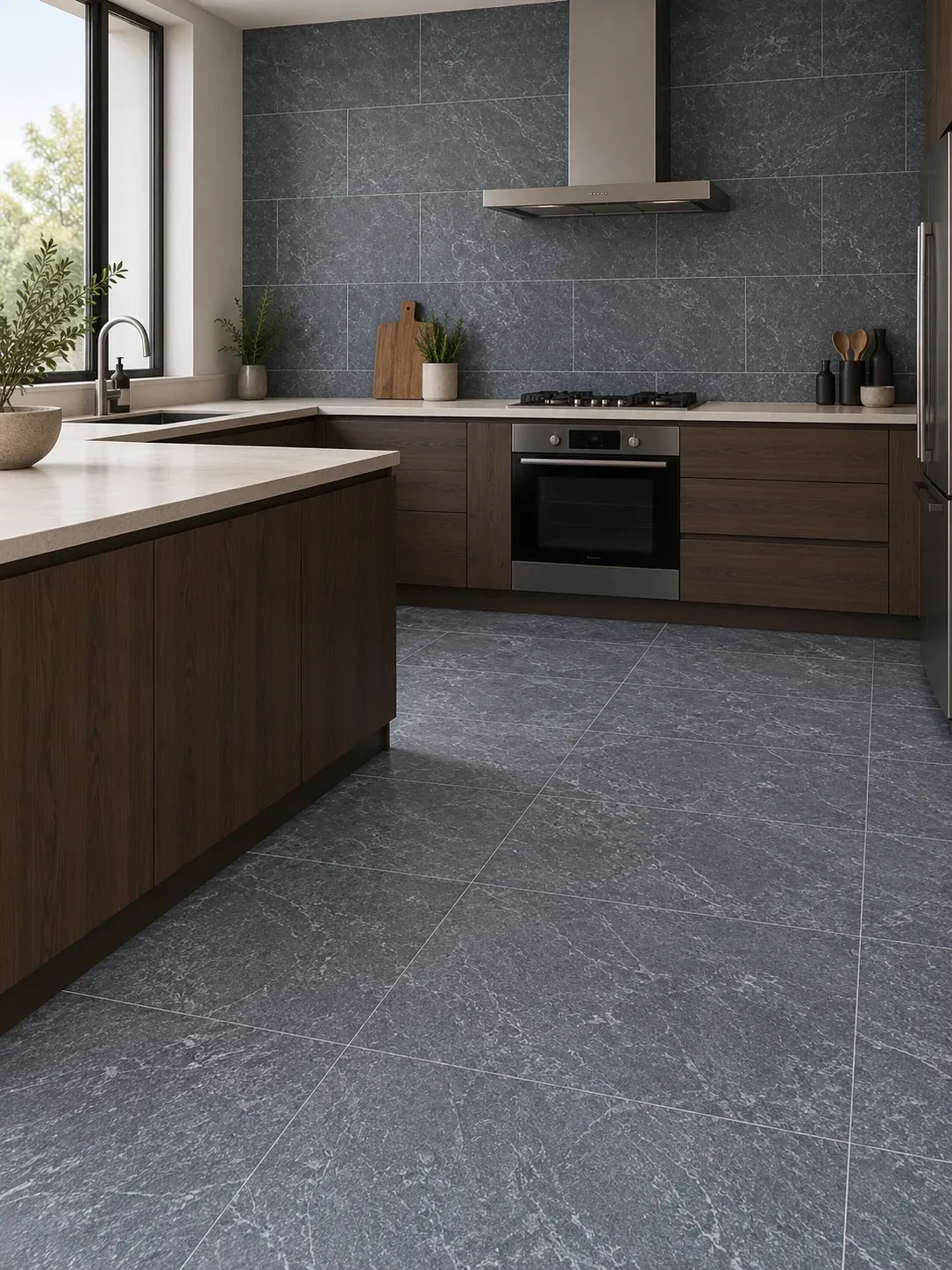
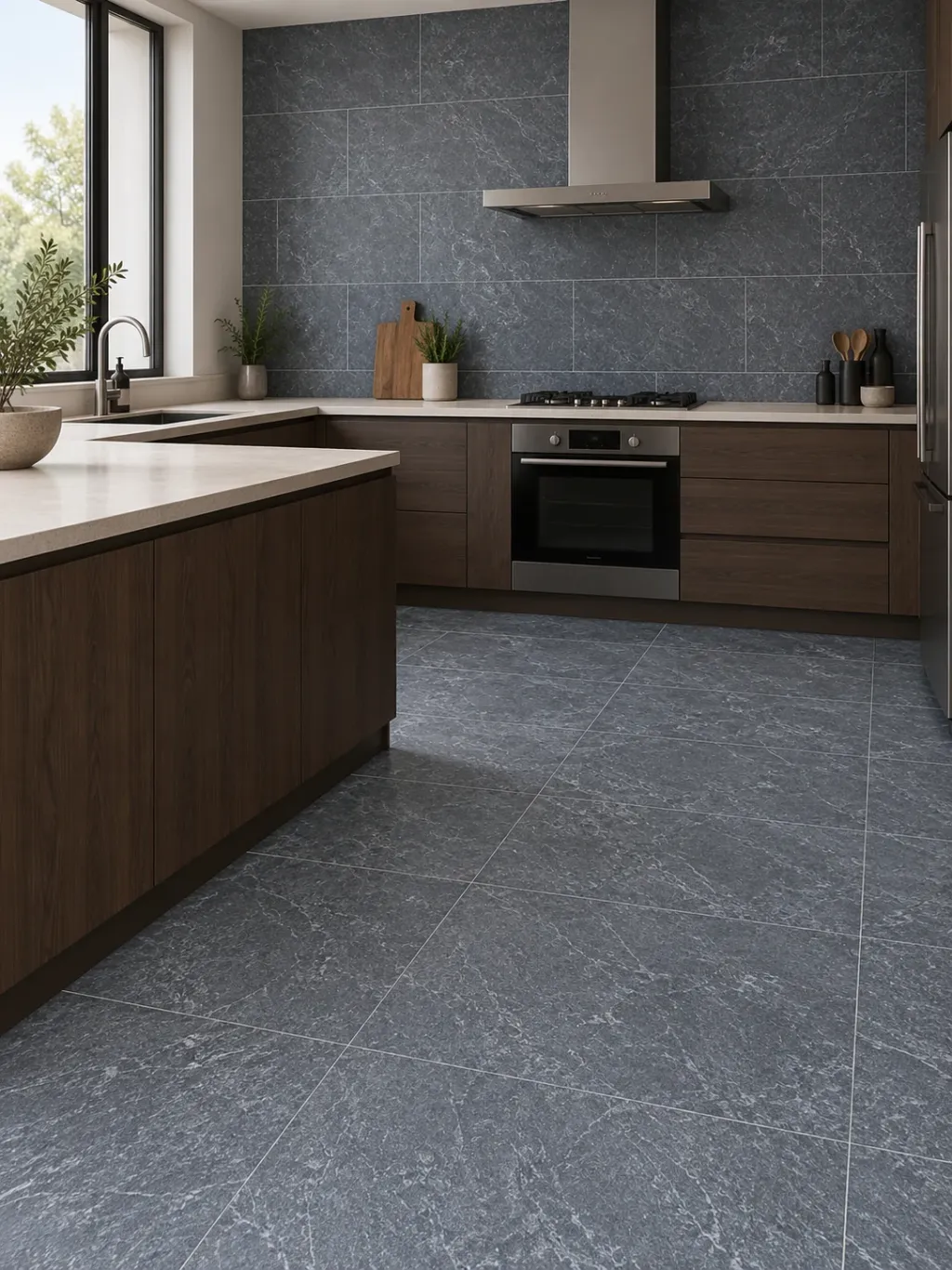
Stone effect porcelain is porcelain made to look like stone. Natural slate and limestone are the real thing, and both are porous: they are usually sealed when laid and resealed over the years, limestone can etch when lemon juice or wine sits on it, and a riven slate face can flake. Stone effect porcelain is dense, so it needs no sealing, and acidic spills will not etch it. Natural stone still wins on authenticity: no two pieces are the same, it can be cleaned back and resealed, and it suits period homes and outdoor paving, where an 11 mm indoor tile does not belong.
This guide puts the three side by side, answers whether slate needs sealing, and says where the real stone is the better choice. If you already know you want the porcelain, browse our stone effect porcelain tiles.
What is stone effect porcelain?
Stone effect porcelain is a fired porcelain tile with the colour and texture of stone on its face. Every Marvra tile is 11 mm rectified porcelain, classified BIa with water absorption of 0.5% or less, and tested to BS EN 14411. Rectified means the edges are cut square after firing, so the tiles can be laid with narrow joints and the floor reads as one surface. Our stone effect tiles have a matt or satin matt finish, never a polished one.
To be clear: these are porcelain tiles with a stone look, not natural stone. They are 11 mm tile for indoor floors and walls. A patio or garden path needs thicker exterior porcelain or proper stone paving, so ask us before using any tile outside.
Slate and limestone in brief
Slate is a natural stone that splits into thin layers. Splitting it gives a riven tile its uneven, textured face, and its colours run from charcoal and blue-grey to green and purple, with real variation from one tile to the next. Riven tiles can vary in thickness, and softer grades can flake or shed thin layers at the surface over time.
Limestone is a natural stone made mostly of calcium carbonate, usually in soft creams, beiges and greys, sometimes with fossil and shell marks. It is porous and reacts with acids, so lemon juice, vinegar, wine and some household cleaners can leave dull etch marks. Travertine is a form of limestone, and we compare it with porcelain in our guide to travertine vs travertine effect porcelain.
Stone effect porcelain vs slate and limestone: side by side
In short, slate and limestone are porous natural stones that need sealing and stone-safe care; stone effect porcelain is dense and needs neither. Each has its own weak points, so here is the full picture.
| Natural slate | Natural limestone | Stone effect porcelain (Marvra) | |
|---|---|---|---|
| Material | Natural stone, split into layers | Natural stone, mostly calcium carbonate | First grade rectified porcelain, 11 mm |
| Water absorption | Porous, varies by quarry and grade | Porous | BIa, 0.5% or less |
| Sealing | Usually sealed, then resealed over time | Sealed, then resealed over time | Never sealed |
| Lemon juice, wine, acidic cleaners | Can stain if left on the surface | Can etch the surface | Will not etch the fired surface |
| Surface wear | A riven face can flake | Softer, can scratch in busy areas | Hard-wearing fired surface |
| Repairs | Can be deep-cleaned and resealed | Can be honed and resealed | A chipped tile is replaced, so keep a few spares |
| Pattern | Every tile is different, strong variation | Every tile is different, softer variation | Printed faces repeat, so lay tiles out dry and mix boxes |
| Underfoot | Feels cool, warms with underfloor heating | Feels cool, warms with underfloor heating | Feels cool, warms with underfloor heating |
| Cutting | Cuts with standard stone tools | Cuts with standard stone tools | Dense, needs a porcelain cutter or wet saw |
| Outdoors | Used as paving in suitable grades | Used as paving in suitable grades | Indoor tile, ask us before outdoor use |
The cost difference is less about the price per m² and more about the years after fitting. Slate and limestone need a sealer, regular resealing and stone-safe cleaners, and limestone may need honing to remove etch marks. Porcelain needs none of them, so it usually costs less to keep.
Where natural slate or limestone still wins
- Authenticity. Every piece is quarried, so the variation is real and never repeats across the floor.
- Texture. A hand-split riven slate face has a depth that a fired tile can only suggest.
- Period homes. If you are matching an old slate hallway or limestone flags in a period house, the real stone is often the right answer.
- Restoration. Limestone can be honed back and slate can be deep-cleaned and resealed, and many people love the patina both take on.
- Outdoors. Stone paving in a suitable grade is made for patios and paths. Our 11 mm porcelain is indoor tile.
If you want the look with less upkeep, porcelain is the easier floor to live with.
Does slate need sealing?
In most homes, yes. Slate is a natural stone with some porosity, so most slate floors are sealed after laying, especially in kitchens, hallways and bathrooms where oil, water and grit meet the surface. Some people also choose a sealer that deepens the colour. Sealers wear, so the floor is resealed from time to time: follow the sealer maker's guidance and your fitter's advice. Limestone needs the same care, and on limestone a sealer slows staining but does not stop acids from etching the surface.
Stone effect porcelain needs no sealer. It is BIa, with water absorption of 0.5% or less, and our finishes are matt and satin matt, not polished. The grout between the tiles is the porous part: keep it clean, and seal cement grout if your fitter recommends it. Day to day, a damp mop with a pH-neutral cleaner is enough.
Choosing a stone effect tile in place of slate or limestone
For a dark slate look: Harrat Anthracite
Harrat Anthracite is a deep, near-black stone effect porcelain with a natural texture and a full matt finish, in large-format 120 x 60 cm. It is the closest tile in our range to a dark slate floor. Darker stone effects hide everyday marks, which makes it a practical choice for kitchens and hallways.
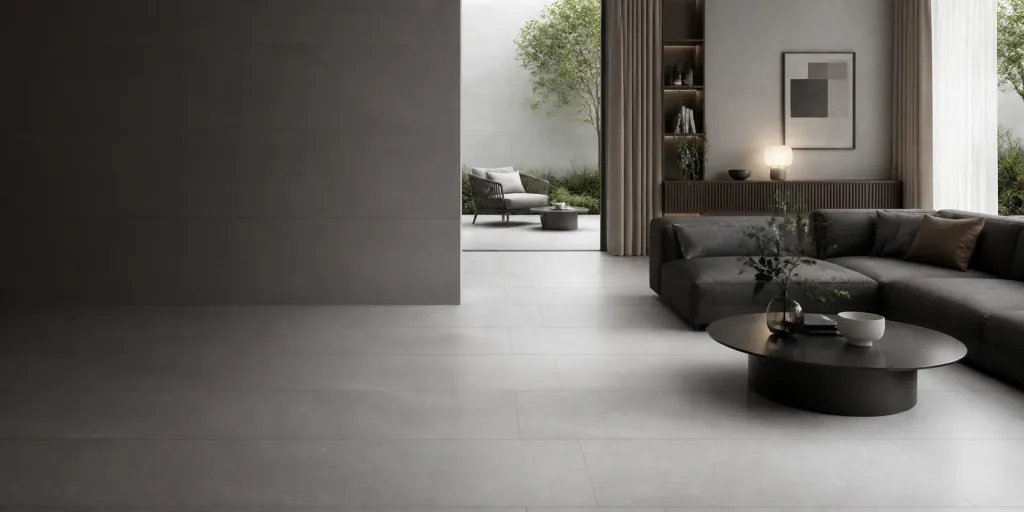
For a grey stone look: Harrat Silver
Harrat Silver is a mineral grey with subtle texture and a matt finish, also in 120 x 60 cm. One tile covers 0.72 m², so the floor has far fewer grout lines and reads as one calm surface. See all our large-format tiles.
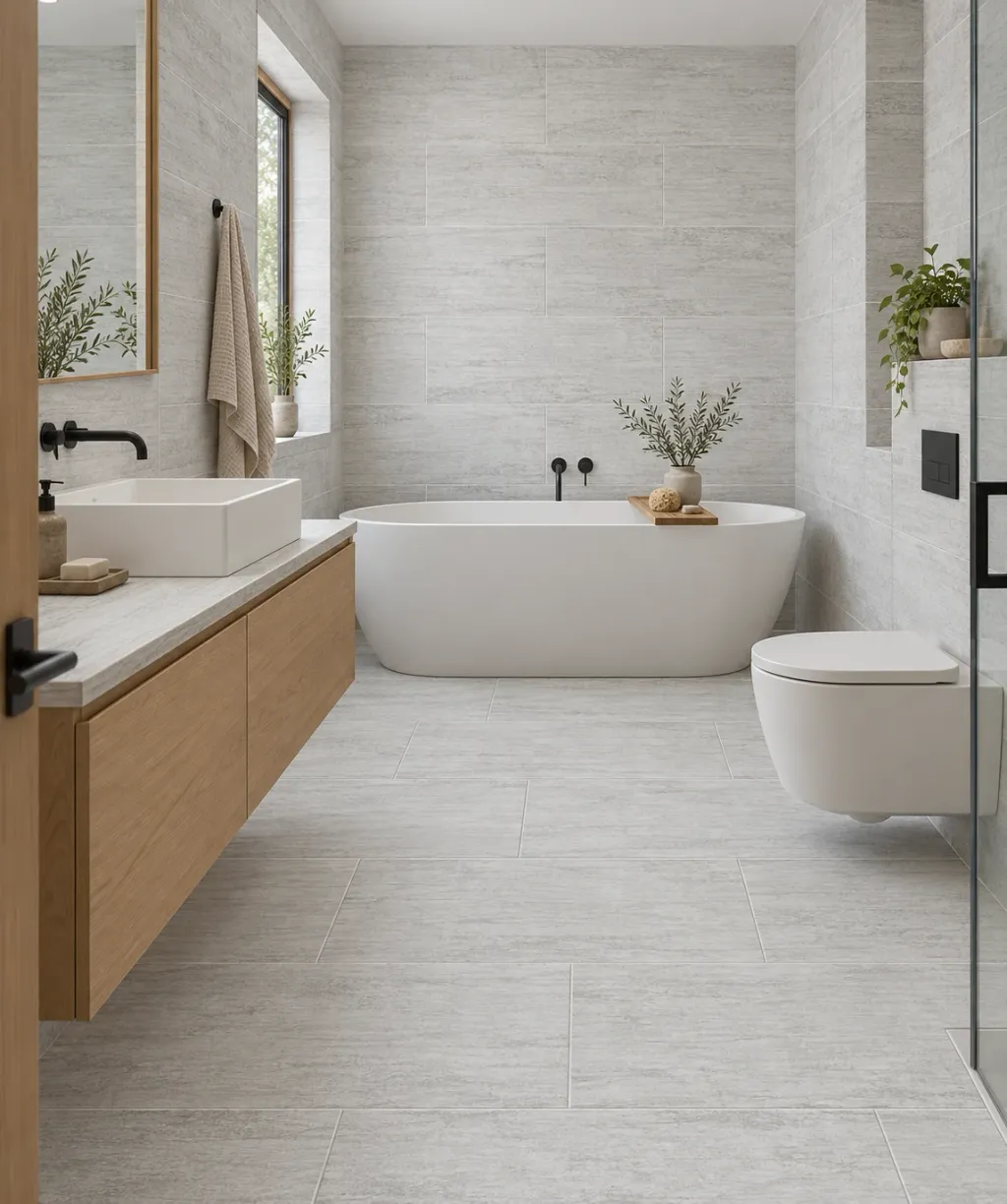
For a calm grey floor and wall: Haven Grey
Haven Grey is a calm grey with a fine texture and a satin matt finish, in 40 x 90 cm. The smaller format is easier to fit around a basin, a WC or a door frame, so it suits bathrooms and cloakrooms, and the same tile can run from floor to wall. For the warm cream and beige tones of limestone, our travertine effect tiles are the closer match.
Pearl, Touch and Safari complete the stone effect range in lighter and warmer tones. They are out of stock at the time of writing, so check Pearl, Touch and Safari for availability.
Prices in October 2026: Harrat Anthracite and Harrat Silver £22.45 per m², Haven Grey £21.62 per m², all inc VAT. Current prices and stock are shown on each tile.
Buy it by the pallet
For a larger floor, buy it by the pallet. Harrat Anthracite and Harrat Silver come as 38.88 m² pallets of 120 x 60 cm tile for £806.00, about £20.73 per m². Haven Grey comes as a 37.80 m² pallet for £756.14, about £20.00 per m². Pallet deals are delivered free in the UK, and stock is limited.
Kitchens, bathrooms and hallways
Kitchens. Oil, wine and lemon juice are everyday kitchen spills, and they are exactly what marks unsealed slate and etches limestone. Porcelain resists staining and wipes clean with a damp cloth. Browse all our kitchen tiles.
Bathrooms. Steam and splashes are no problem for a tile that needs no sealing. For shower floors and other wet areas, ask us to confirm the format and finish for your project before you order.
Hallways. Grit and wet shoes wear a soft stone over the years. Stone effect porcelain is harder wearing than natural stone, and a dark tone such as Harrat Anthracite hides the marks between cleans.
Slip resistance. A riven slate face is naturally uneven, while honed limestone and matt porcelain are smoother. Floor tiles are often rated on the R scale (R9 to R13, higher is more grip) or by a pendulum test value (PTV). For a bathroom floor, a kitchen by the back door or a shower area, ask us for the figure for the exact tile and finish before you order, and tell us where it is going.
Fitting. Ask your fitter for a flexible tile adhesive suited to porcelain, especially over underfloor heating and for large formats. Large tiles need a flat, well-prepared base. Order around 10% extra for cuts and breakages; the calculator on each product page works out the boxes for you.
See the tiles before you order
Grey and charcoal tones shift with the light, so see them in your own room before you commit. Order a sample for £1.99. Samples are 10 x 10 cm, you can choose up to 10 shades, and the cost is credited back against your tile order.
You can also see the range at our showroom at 20a Western Avenue, London W3 7TZ. Check opening hours and get free advice on our contact page, by phone or on WhatsApp.
Tiles are delivered in 1 to 3 days on a pallet. UK delivery is free on product orders over £349 and £89.95 below, and you can pay in 3 with Klarna. Ready to choose? Browse our stone effect porcelain tiles.
Your questions
Does slate need sealing?
In most homes, yes. Slate is a natural stone with some porosity, so most slate floors are sealed after laying, especially in kitchens, hallways and bathrooms, and resealed from time to time as the sealer wears. Follow the sealer maker's guidance and your fitter's advice.
Does stone effect porcelain need sealing?
No. Stone effect porcelain is non-porous (BIa, water absorption 0.5% or less), so the tile needs no sealer. Our finishes are matt and satin matt, not polished. The grout between the tiles is the porous part: keep it clean, and seal cement grout if your fitter recommends it.
Is porcelain better than limestone for a floor?
For most homes, it is more practical. Limestone is porous, needs sealing and can etch when lemon juice, wine or acidic cleaners sit on it. Stone effect porcelain needs no sealing and will not etch. Limestone suits people who want a real stone that can be honed back and ages with the house.
Is stone effect porcelain cheaper than slate or limestone?
Over the life of the floor it usually costs less to keep: there is no sealer, no resealing and no stone-safe cleaners to buy. Compare the price per m² of the tile you like, then add the upkeep the stone needs. Our current prices are on each tile.
Is stone effect porcelain slippery?
It depends on the finish and where it goes. Matt finishes give more grip than polished ones, and all our stone effect tiles are matt or satin matt. For bathroom floors and wet areas, ask us for the slip figure of the exact tile before ordering.
Can stone effect porcelain be used outside?
Our stone effect range is 11 mm tile for indoor walls and floors. Outdoor paving needs thicker exterior porcelain or stone paving, so ask us before using any tile outside.
Can I see the tiles before ordering?
Yes. Samples cost £1.99 each, credited back against your tile order, or visit our showroom in London W3. Full tile orders are delivered in 1 to 3 days.