

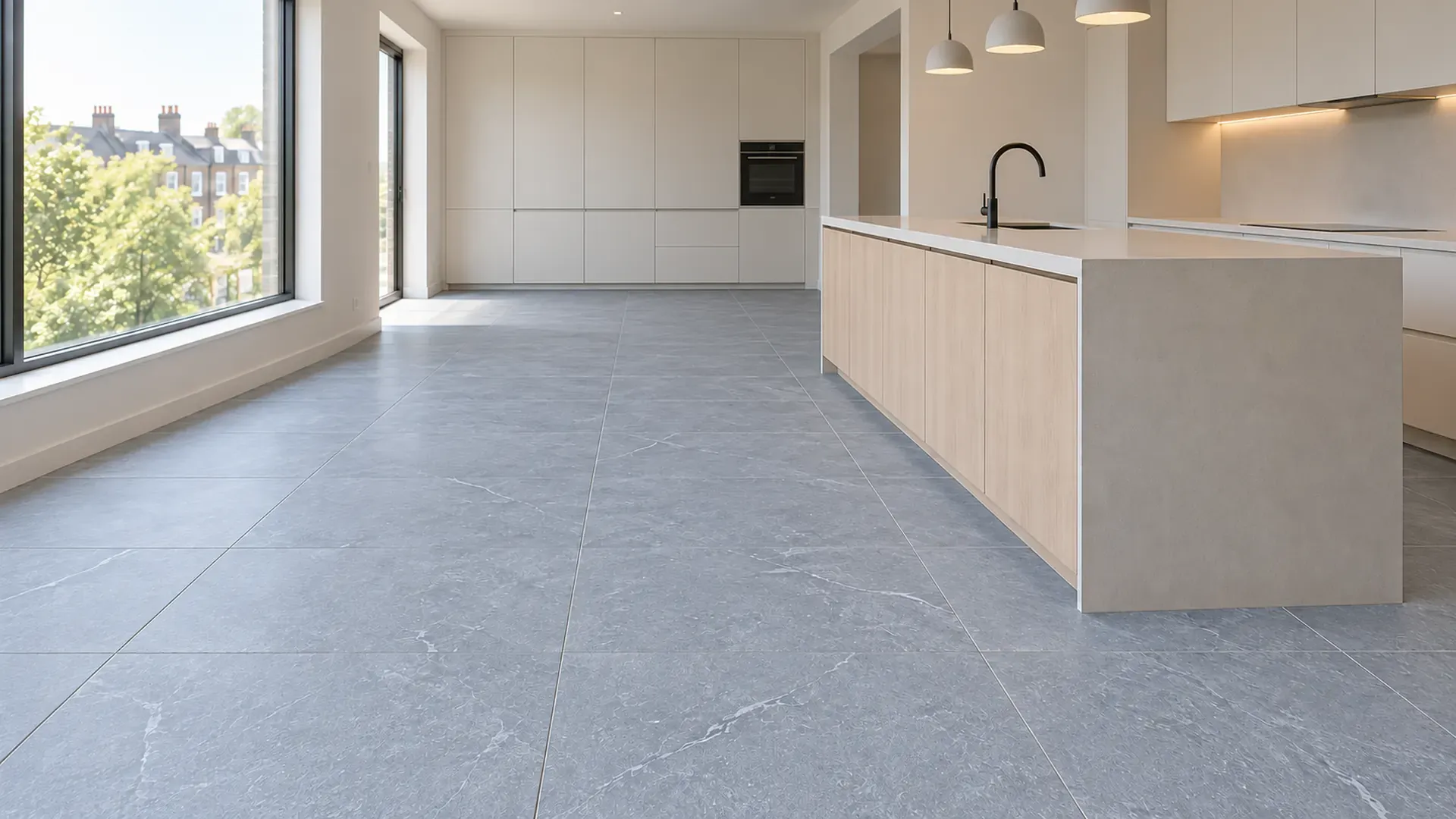
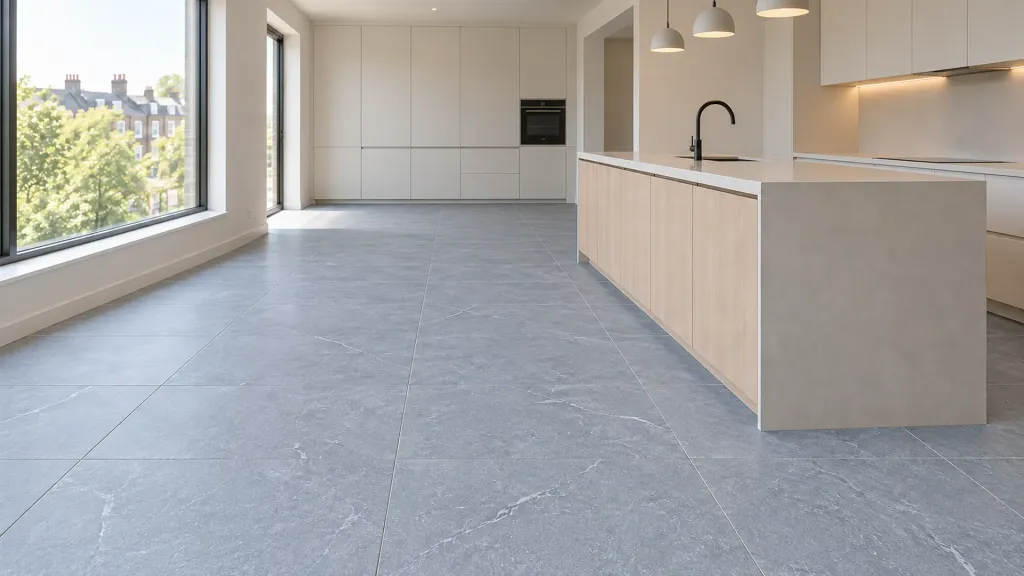
The best floor tiles for most UK kitchens are porcelain tiles in a matt or structured finish: dense enough to shrug off water, oil and dropped pans, with more grip underfoot than a polished tile. Size them to the room, with large-format 120 x 60 cm tiles for a big or open-plan kitchen and 30 x 60 cm or 40 x 90 cm tiles for a galley or a smaller one.
That still leaves colour, grout, underfloor heating and budget. This guide takes each decision in turn, then names the tiles we would shortlist from our current stock. If you already know what you want, browse our kitchen floor tiles.
What a kitchen floor has to cope with
A kitchen floor takes water by the sink, oil by the hob, dropped pans and steady traffic to the back door. So it has to resist water and stains, wear well, give grip when wet and clean quickly. Everything below follows from those four points.
Porcelain, ceramic, natural stone or vinyl?
Porcelain is fired at high temperature from fine clay, so it is very dense and absorbs almost no water. Every Marvra tile is 11 mm rectified porcelain, classified BIa with water absorption of 0.5% or less, and tested to BS EN 14411. It needs no sealing, resists oil and wine, and wipes clean with a damp mop. The downsides are real: it is hard and cool underfoot, a dropped glass will usually break, and a chipped tile has to be replaced, so keep a few spares.
Ceramic tiles have a softer, more absorbent body under a glazed face. They are lighter and easier to cut, which makes them a good choice for walls and splashbacks. On a busy floor, a deep chip can show the different coloured body beneath, which is why most people choose porcelain for the floor itself.
Natural stone such as slate, limestone or travertine has real character, and no two pieces match. It is porous, so it is sealed when laid and resealed over the years, and limestone and travertine can etch where lemon juice or vinegar sits. If you love the look but not the upkeep, read our guides to stone effect porcelain vs slate and limestone and travertine vs travertine effect porcelain.
Vinyl and LVT (luxury vinyl tile) are warmer, softer and quieter underfoot, and kinder to a dropped glass. They are thin and usually quick to fit. On the other hand, they can dent under heavy appliances, scuff where grit is walked in, and a worn plank cannot be refinished, only replaced.
| Porcelain | Ceramic | Natural stone | Vinyl / LVT | |
|---|---|---|---|---|
| Water | Absorbs almost none (ours: BIa, 0.5% or less) | Glazed face resists it, body is more absorbent | Porous, needs sealing | Waterproof face, seams and edges need care |
| Oil and wine | Resists staining | Glaze resists staining | Can stain or etch unless sealed | Resists most spills |
| Wear | Very hard-wearing | Glaze can chip | Softer stones scratch, many age well | Can dent and scuff |
| Upkeep | Damp mop, never sealed | Damp mop, never sealed | Sealer, resealing, stone-safe cleaners | Damp mop, never sealed |
| Underfoot | Hard and cool, warms with underfloor heating | Hard and cool | Hard and cool | Softer and warmer |
| Repairs | Replace a chipped tile, keep spares | Replace a chipped tile | Can be honed and resealed | Replace the damaged plank or tile |
For a kitchen floor that has to last, porcelain is the safest all-round choice. Vinyl wins on comfort and natural stone on character, if those matter more to you.
Non-slip kitchen floor tiles: what the finish does
No hard floor is fully non-slip when it is wet and greasy. What you can choose is the finish. A matt or structured surface gives more grip than a polished one, and it also hides water spots and smears. Every tile we sell is matt: full matt on Harrat, satin matt on Haven and Ascoli, and a structured matt on the 30 x 60 cm Cava Veins tiles, which adds a light texture you can feel underfoot.
Slip resistance is tested with a ramp test (the R rating) or a pendulum test (PTV). If your kitchen opens onto a garden door, or young children or older relatives use it every day, ask us for the figure for the exact tile and finish before you order. Whatever you choose, wipe spills straight away and put a mat at the back door.
Light, beige or dark kitchen floor tiles?
Light floors keep a kitchen bright, which matters most in a north-facing room or a narrow galley. Beige and cream travertine looks, such as Ascoli Beige or Cava Veins Cream, sit well with oak, painted or white units. They do show coffee drips and dark crumbs sooner.
Darker stone effects hide everyday marks, so a near-black floor such as Harrat Anthracite forgives a busy family kitchen. It shows dust, flour and dried water marks more than a mid tone does. Mid greys such as Harrat Silver and Haven Grey sit between the two and hide the most. Colour shifts with the light, so judge a sample on your own floor, by day and in the evening.
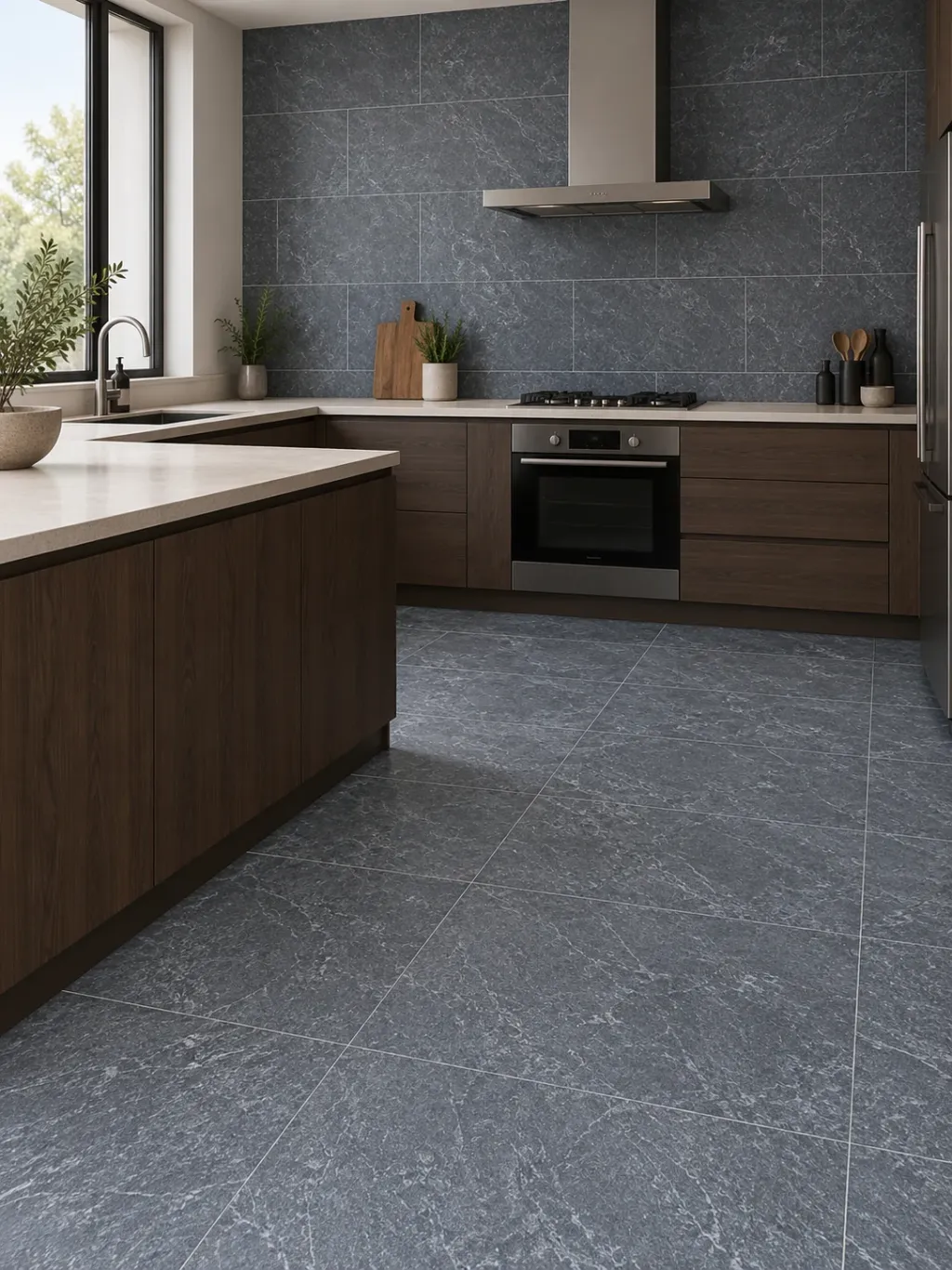
Tile size: large format, 40 x 90 or 30 x 60?
120 x 60 cm. Large-format tiles mean fewer joints, and that matters most around the cooker and the sink, where grout collects grease. One tile covers 0.72 m², so an open-plan kitchen-diner reads as one calm surface. They need a flat, well-prepared floor and usually two people to lay. Our guide to 120 x 60 tiles, pros and cons covers the fitting in detail.
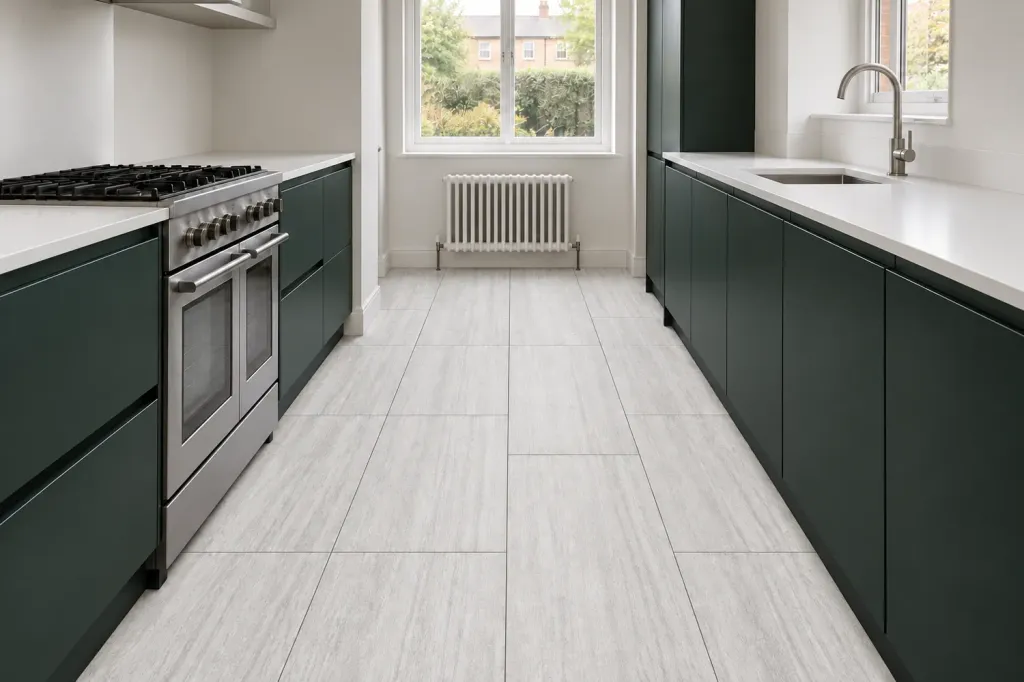
40 x 90 cm. One tile covers 0.36 m². It still gives a large-tile look with fewer joints than smaller formats, and it is easier to handle in a mid-sized kitchen.
30 x 60 cm. One tile covers 0.18 m². It is the easiest size to fit around an island, plinths and door frames, so it suits smaller kitchens and galleys. The trade-off is more grout lines to keep clean. In a galley, lay the long side along the room to draw the eye down its length.
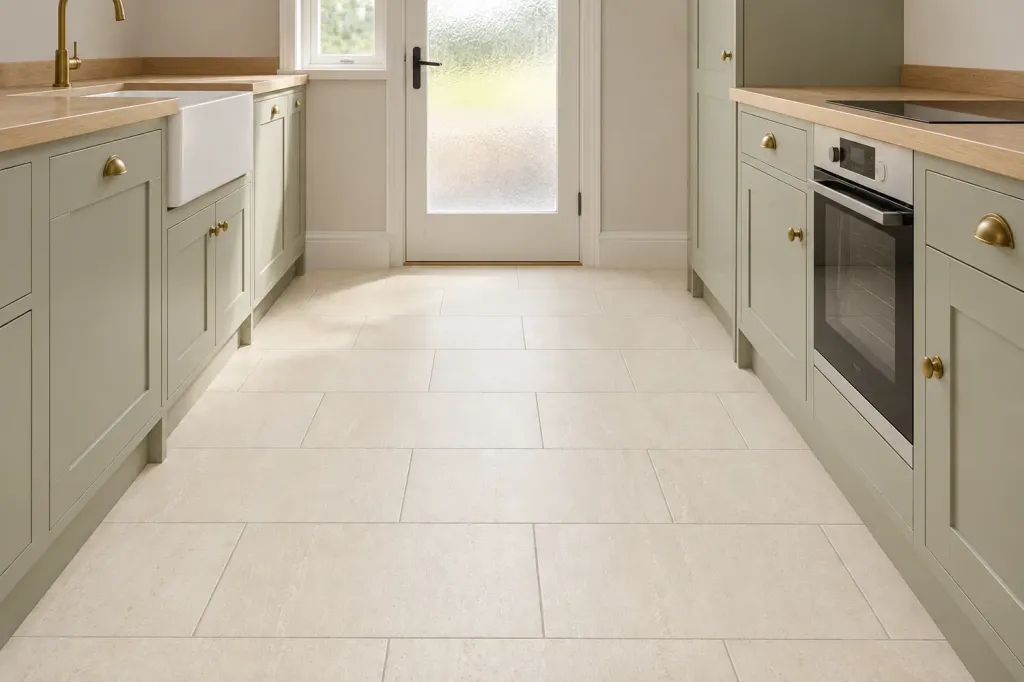
The same 30 x 60 cm tile also works on a splashback, so one tile can run from floor to wall.
Grout colour
Grout is the part of a tiled floor that shows dirt first. Our tiles are rectified, so your fitter can use narrow joints, which leaves less grout to clean. Choose a grout close to the tile colour so the floor reads as one surface. On a light beige or cream tile, a light beige or warm grey grout hides kitchen grime far better than bright white. On Harrat Anthracite, a dark grey or anthracite grout keeps the grid quiet. Ask your fitter about a stain-resistant grout for the kitchen, and seal cement grout if they recommend it.
Underfloor heating
Porcelain works well over underfloor heating: it carries the warmth up into the room, and it deals with the cold feel of a tiled floor. All six tiles in our picks below are listed as suitable for underfloor heating on their product pages. Follow the heating maker's guidance on bringing the system up to temperature, and ask your fitter for a flexible tile adhesive suited to porcelain.
How much to order
Measure the floor in metres, length times width, splitting an L-shaped room into rectangles. Add 10% for cuts and breakages; the calculator on each product page works out the boxes. Tiling under the units uses more tile but lets you change the layout later, while tiling to the plinths saves tiles. Keep a box back for repairs, because a later batch may differ slightly in shade.
Budget by m²
Prices in October 2026 (sale prices, inc VAT):
- Cava Veins Beige and Cava Veins Cream, 30 x 60 cm: £19.12 per m² (was £22.95)
- Ascoli Beige and Haven Grey, 40 x 90 cm: £21.62 per m² (was £25.95)
- Harrat Anthracite and Harrat Silver, 120 x 60 cm: £22.45 per m² (was £26.95)
For example, a 15 m² kitchen plus 10% needs 16.5 m². That is 16 boxes of Cava Veins (17.28 m²), about £330, or 12 boxes of Harrat (17.28 m²), about £388. UK delivery is free on product orders over £349 and £89.95 below, or you can collect free from our London W3 store. Budget separately for adhesive, grout, floor preparation and fitting.
For a big kitchen-diner of about 35 m² or more, a full pallet costs less than buying by the box. Cava Veins Beige and Cream come as 38.88 m² pallets for £686.38 (about £17.65 per m²), Ascoli Beige and Haven Grey as 37.80 m² pallets for £756.14 (about £20.00 per m²), and Harrat Anthracite and Silver as 38.88 m² pallets for £806.00 (about £20.73 per m²). See our pallet deals, delivered free in the UK while limited stock lasts, and our guide to how many m² are on a pallet of tiles.
Our picks for a kitchen floor
All six are in stock as we write, in limited quantities, so check each tile for availability.
- Harrat Anthracite, 120 x 60 cm, matt. A near-black stone effect that hides spills in a busy kitchen, though it shows dust and flour more than a mid tone.
- Harrat Silver, 120 x 60 cm, matt. A mineral grey that hides everyday marks well, with few joints in an open-plan room.
- Haven Grey, 40 x 90 cm, satin matt. A calm grey that is easier to fit than 120 x 60; the satin matt face has a soft sheen, so ask us for the slip figure if it is going by a back door.
- Ascoli Beige, 40 x 90 cm, satin matt. A warm beige travertine look that keeps a kitchen bright, at the cost of showing dark crumbs sooner.
- Cava Veins Beige, 30 x 60 cm, structured matt. A warm base with fine linear veining and a light texture underfoot, at the lowest price per m² of the six, with more grout lines to keep clean.
- Cava Veins Cream, 30 x 60 cm, structured matt. The lightest of the six, ideal for a small or north-facing kitchen, with the same textured grip and the same extra joints.
See the tiles before you order
Floor colours change with the light, so see them in your own kitchen before you commit. Order a sample for £1.99. Samples are 10 x 10 cm, you can choose up to 10 shades, and the cost is credited towards your tile order.
You can also see the range at our showroom at 20a Western Avenue, London W3 7TZ, open Monday to Friday 9am to 5pm and Saturday 10am to 4pm. Plan your visit or ask for free advice on our contact page.
Tiles are delivered in 1 to 3 days on a pallet. Ready to choose? Browse our kitchen floor tiles.
Your questions
What are the best floor tiles for a kitchen in the UK?
For most UK kitchens, porcelain tiles in a matt or structured finish. Porcelain is dense, needs no sealing and resists water, oil and wear, and a matt or structured face gives more grip than a polished one. Choose 120 x 60 cm for a large or open-plan kitchen and 30 x 60 cm or 40 x 90 cm for a smaller one.
Are porcelain floor tiles slippery in a kitchen?
It depends on the finish. Matt and structured finishes give more grip than polished ones, and every tile we sell is matt, satin matt or structured matt. No hard floor is fully non-slip when wet, so wipe spills straight away, and ask us for the slip figure of the exact tile if it is going by a back door.
Are light or beige floor tiles a good idea in a kitchen?
Yes, if you want a bright kitchen. Light and beige tiles reflect daylight, which helps in a north-facing room or a galley. They show coffee drips and dark crumbs sooner than a mid grey, so pick a grout close to the tile colour and keep a mop handy.
Should kitchen floor tiles be large or small?
Large-format 120 x 60 cm tiles mean fewer joints around the cooker and sink and suit open-plan rooms, but they need a flat floor. 30 x 60 cm tiles are easier to fit around islands, plinths and door frames in a small kitchen. 40 x 90 cm sits between the two.
What colour grout is best for a kitchen floor?
A grout close to the tile colour. On light beige or cream tiles, a light beige or warm grey grout hides kitchen grime better than bright white. On dark tiles, use a dark grey or anthracite grout. Ask your fitter about a stain-resistant grout.
Can kitchen floor tiles go over underfloor heating?
Yes. Porcelain carries heat well, and all six of our in-stock tiles are listed as suitable for underfloor heating. Follow the heating maker's guidance and ask your fitter for a flexible adhesive suited to porcelain.
How many extra tiles should I order for a kitchen?
Add 10% to the floor area for cuts and breakages, and keep a box back for repairs. The calculator on each product page works out the boxes for you.
Can I see the tiles before ordering?
Yes. Samples cost £1.99 each, credited towards your tile order, or visit our showroom in London W3. Full tile orders are delivered in 1 to 3 days.