

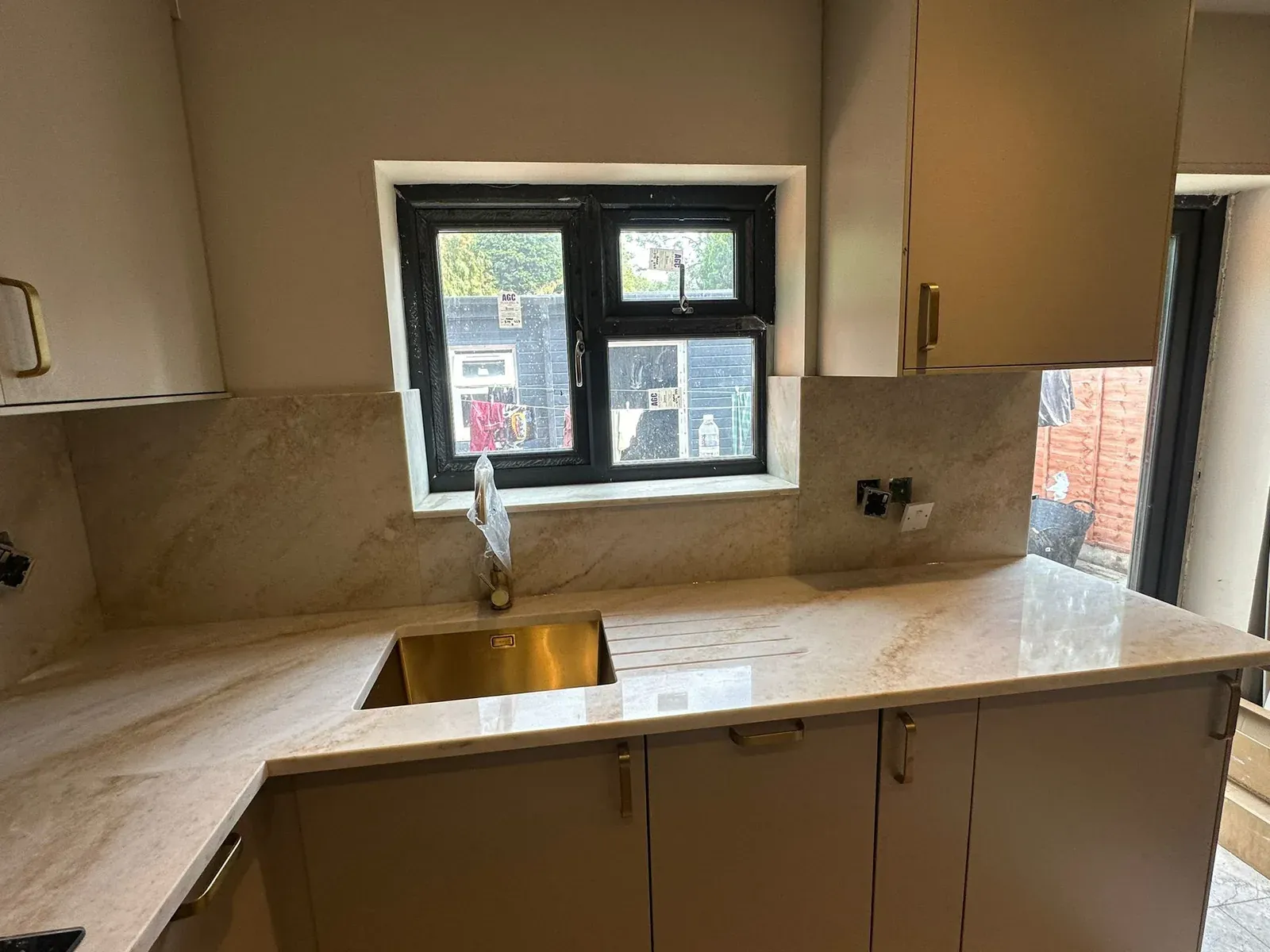
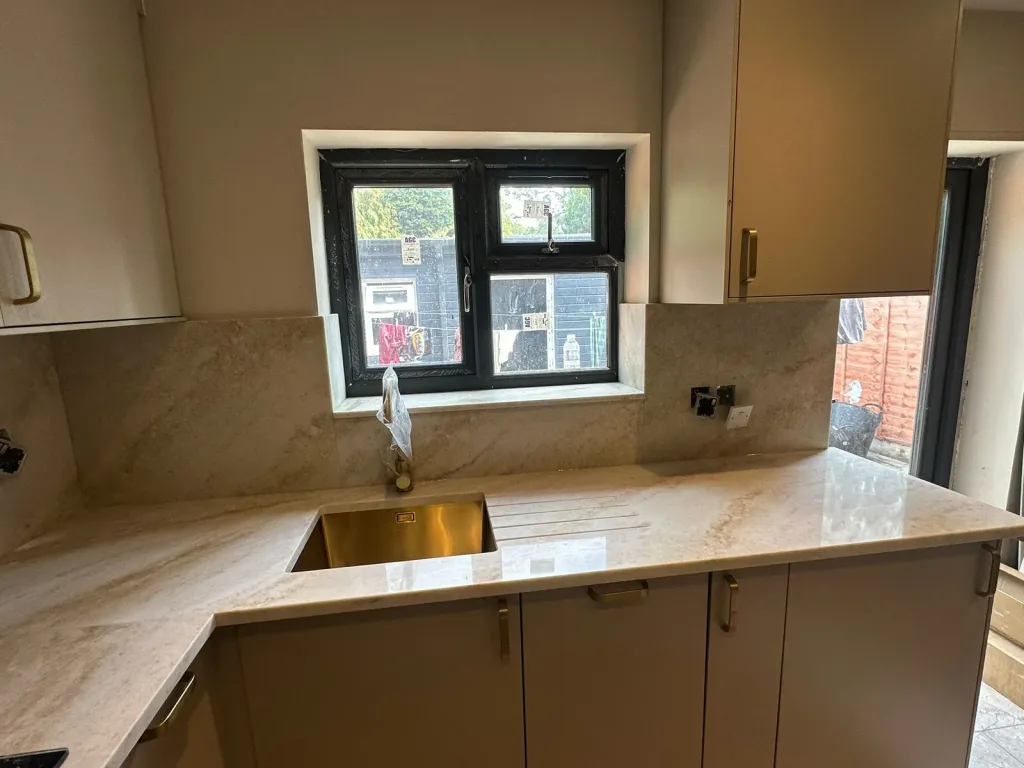
The easiest way to match a kitchen worktop and floor tiles is to let one surface lead and keep the other quiet: a veined worktop over a plain, warm floor, or a plain worktop over a floor with movement. Then pick one shared colour, either the base tone or the colour of the veins, so the two read as one room rather than two showrooms.
This guide walks through the combinations that work, in the materials we sell: porcelain floor tiles and stone worktops in quartz, quartzite, marble, granite, porcelain and onyx. If you already have a stone in mind, browse our kitchen worktops or our kitchen floor tiles.
Decide which surface leads
A worktop sits at eye level and catches the light, so it is usually the surface people notice first. If you love a strongly veined stone such as Calacatta Gold quartz, let it lead and choose a floor with a soft, even surface. If the floor is the feature, for example a marble effect porcelain with clear veining, choose a calmer worktop such as Super White quartz.
Two busy surfaces fight each other. Two plain surfaces can look flat. One of each is the safe middle.
Combinations that work
Veined white worktop, warm travertine effect floor. A white quartz with grey or gold veins over a beige floor such as Cava Veins Beige or Cava Veins Cream keeps the room light without feeling cold. Pick a worktop whose veins share the warmth of the floor: gold veins with beige, grey veins with cream.
Black worktop, light stone effect floor. A dark stone such as Cosmic Black granite gives a strong line along the units. A pale floor stops the room closing in; a grey stone effect tile such as Harrat Silver keeps the contrast without going stark.
Marble effect floor, plain worktop. If you want movement underfoot, the marble effect tiles do that job, and a quiet white or grey quartz keeps the worktop from competing.
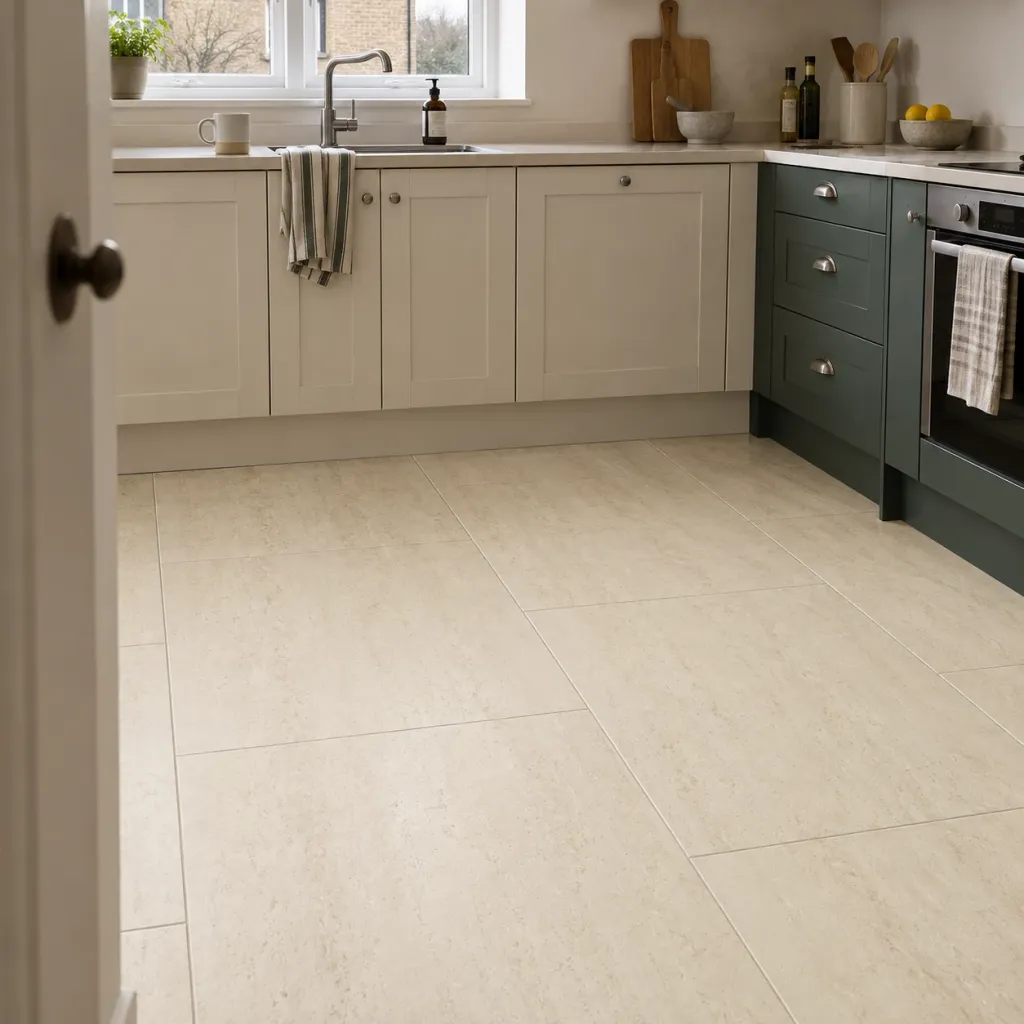
Beige quartzite, beige floor. Tone on tone works when the textures differ. A natural stone such as Taj Mahal Cream Quartzite over a matt beige porcelain floor gives a calm, warm kitchen. Keep the grout close to the floor colour so the floor reads as one surface.
Dark floor, light worktop. A charcoal floor such as Harrat Anthracite grounds an open-plan kitchen. Pair it with a light worktop so the work surface stays bright where you need to see what you are doing.
Match the undertone, not the exact colour
Floor and worktop rarely match exactly, and they do not need to. What matters is the undertone. Warm floors (beige, cream, sand) sit well with worktops that have warm veins or a cream base. Cool floors (grey, silver, charcoal) sit well with white, grey or black worktops. Hold a sample of each next to the other in daylight, by the window where the kitchen will be, before you decide.
Think about finish and grip
A polished worktop and a matt floor is the usual combination, and a good one: the worktop is easy to wipe and the floor gives grip underfoot, which matters near the sink. Our porcelain floor tiles are 11 mm rectified porcelain, so the joins can be thin and the floor reads as one surface under the run of units.
Upstands and splashbacks in the same stone
The simplest way to tie a worktop to the rest of the room is to carry the same stone up the wall behind it. Upstands and splashbacks cut from the same slab give one continuous line from the worktop to the wall, and leave the floor tile free to be the second material in the room.
Check thickness and lead times together
Worktops come in 20 mm or 30 mm, depending on the stone. A 30 mm edge looks heavier and suits a large island; 20 mm looks lighter and suits a slim run of units. Plan the floor first if you can: worktops are templated after the base units are in, so the floor tiles and the units need to be down before we measure.
How to choose, step by step
- Pick the surface you love most and let it lead.
- Choose the other surface plainer, in the same undertone.
- Order floor tile samples and look at them next to the worktop stone in daylight.
- Decide the worktop thickness and whether you want upstands in the same stone.
- Get a free worktop quote: we measure, cut the stone and fit it.
Want a second opinion? Send us a photo of your kitchen and the floor you like on WhatsApp, and we will suggest worktops that suit it.