

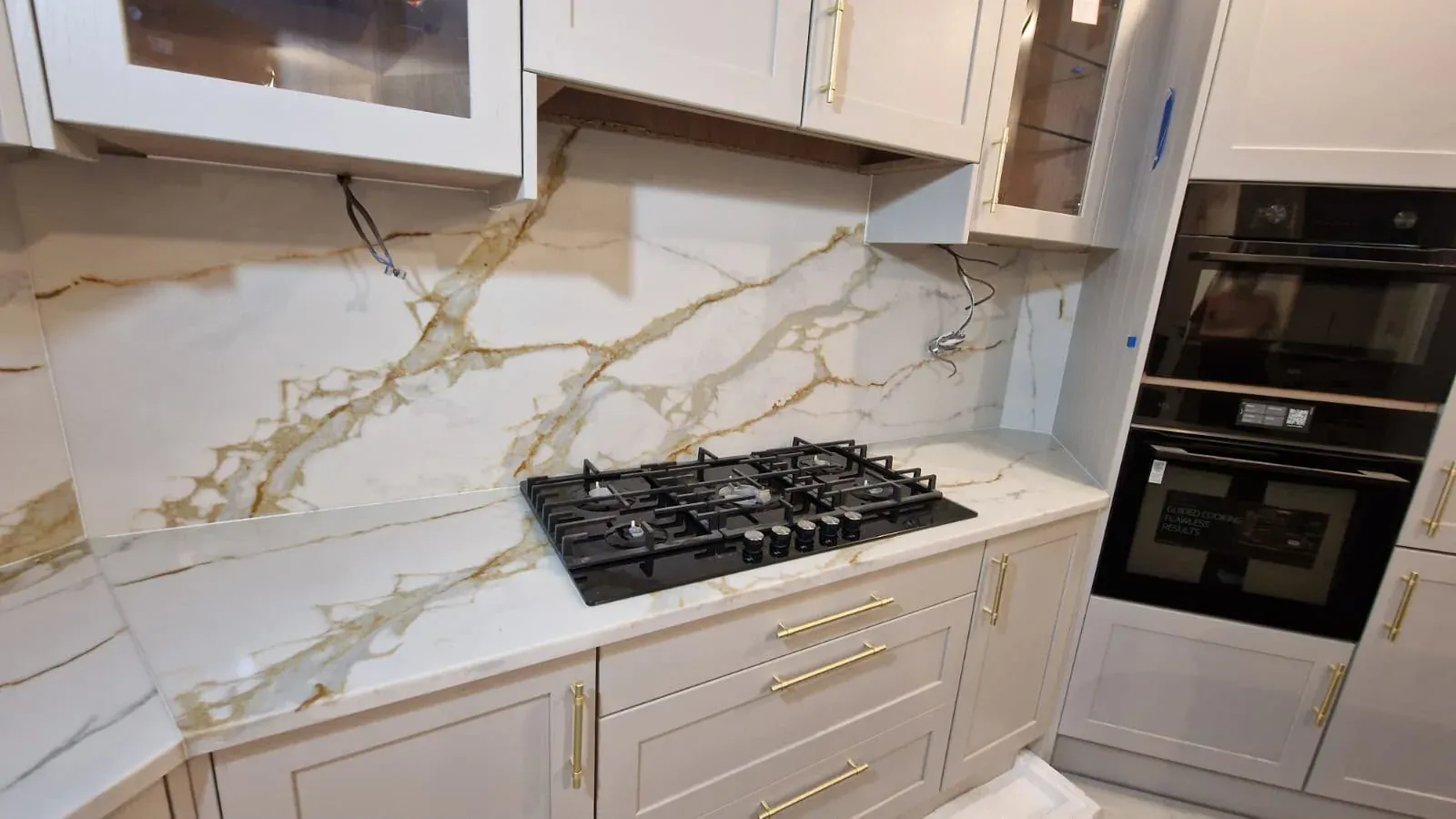
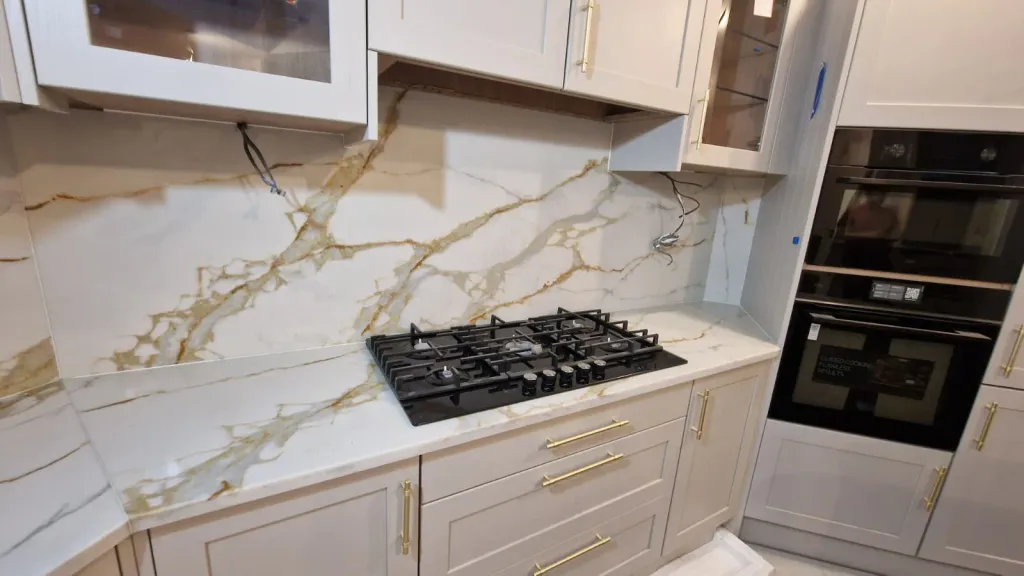
Above a kitchen worktop you have four choices: leave the wall and seal the joint, fit a short upstand in the same stone, tile the wall, or carry the stone all the way up as a full-height splashback. The right one depends on what you want to clean, what you want to see, and what you want to spend. Many fitters call anything under about 200 mm an upstand and anything taller a splashback.
Use the switcher below to see each option on the same wall, then the guide picks one for your kitchen. If you already know what you want, see our upstands and splashbacks or get a free worktop quote.
What an upstand does
An upstand is a strip of the worktop stone, usually about 100 mm high, fixed to the wall along the back edge of the worktop. It does two things. It closes the joint between worktop and wall, which otherwise relies on a bead of sealant, and it takes the water and food that land at the back of the worktop, especially behind the sink.
Because it is cut from the same slab, the colour and veining match the worktop. That is the difference with a plastic or laminate trim: the joint disappears into the stone instead of being covered by something else.
Upstand and tiles together
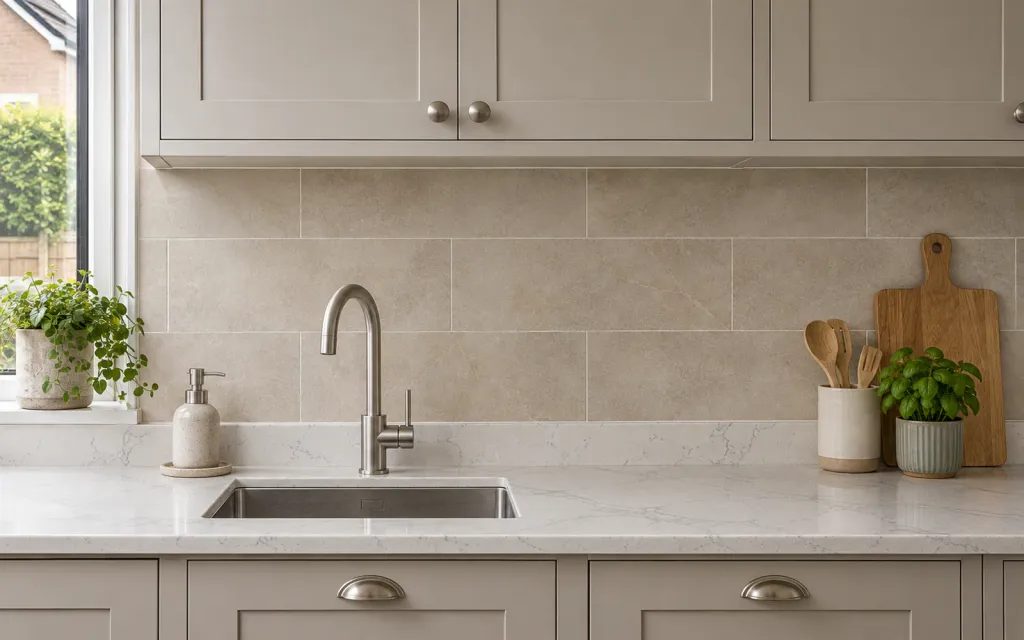
The most common mix in UK kitchens is a stone upstand with tiles above it. The upstand protects the joint, the tiles cover the rest of the wall up to the wall cupboards, and you choose the tile for colour or pattern. Porcelain wall tiles suit this well because they absorb almost no water; our kitchen tiles are 11 mm rectified porcelain, so the joints can be thin.
If you go this way, finish the tiles neatly on the top of the upstand and keep the grout colour close to the tile, so the wall reads as one surface.
A full-height stone splashback
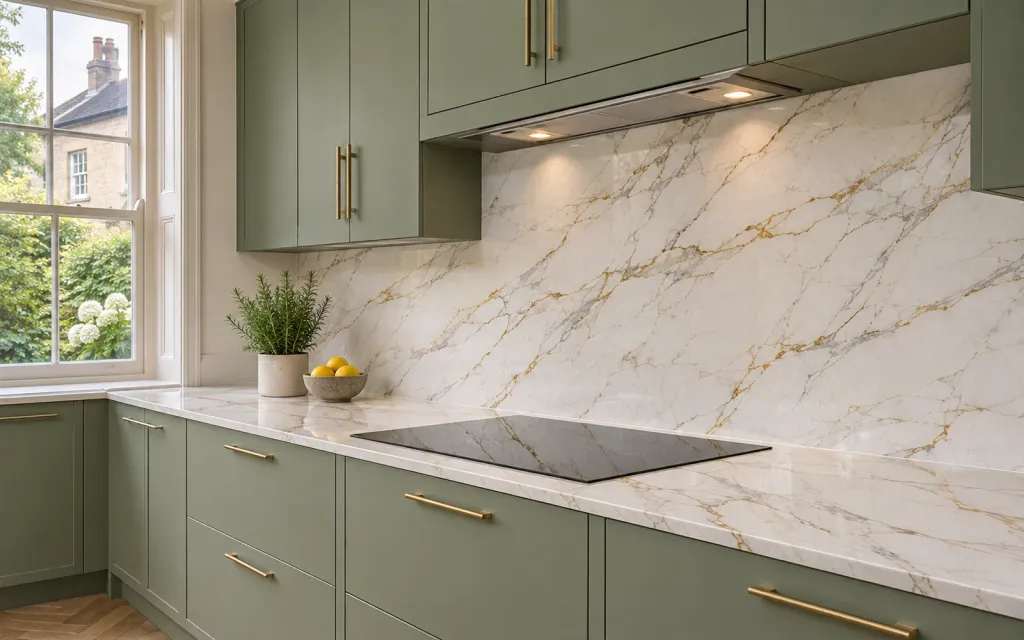
A splashback carries the worktop stone up the wall, to the wall cupboards, the extractor or the ceiling. With a veined stone the pattern continues from the worktop up the wall, which is why it is so often chosen behind a hob or a range. There is no grout to clean and nothing to replace.
It uses more stone than an upstand, so it costs more, and the wall has to be checked before anything is cut. We template on site and tell you about sockets, the extractor and anything on the wall before cutting. Behind a gas hob, tell us the hob type: quartz is bound with resin and should not take direct heat from a flame, while granite and porcelain cope better.
Which one suits your kitchen?
Before you ask for a quote
How it is made and fitted
Upstands and splashbacks are cut from the same slab as the worktop, in our workshop, once the kitchen has been templated. We check on site whether the wall is straight before anything is cut, then fit the worktop first and the upstands or splashback after. You can mix them: an upstand along the run, a splashback behind the hob and a waterfall end on the island.
Want a price for your wall? Get a free quote: leave your number or email and we call you, or send us a photo of your kitchen on WhatsApp.