

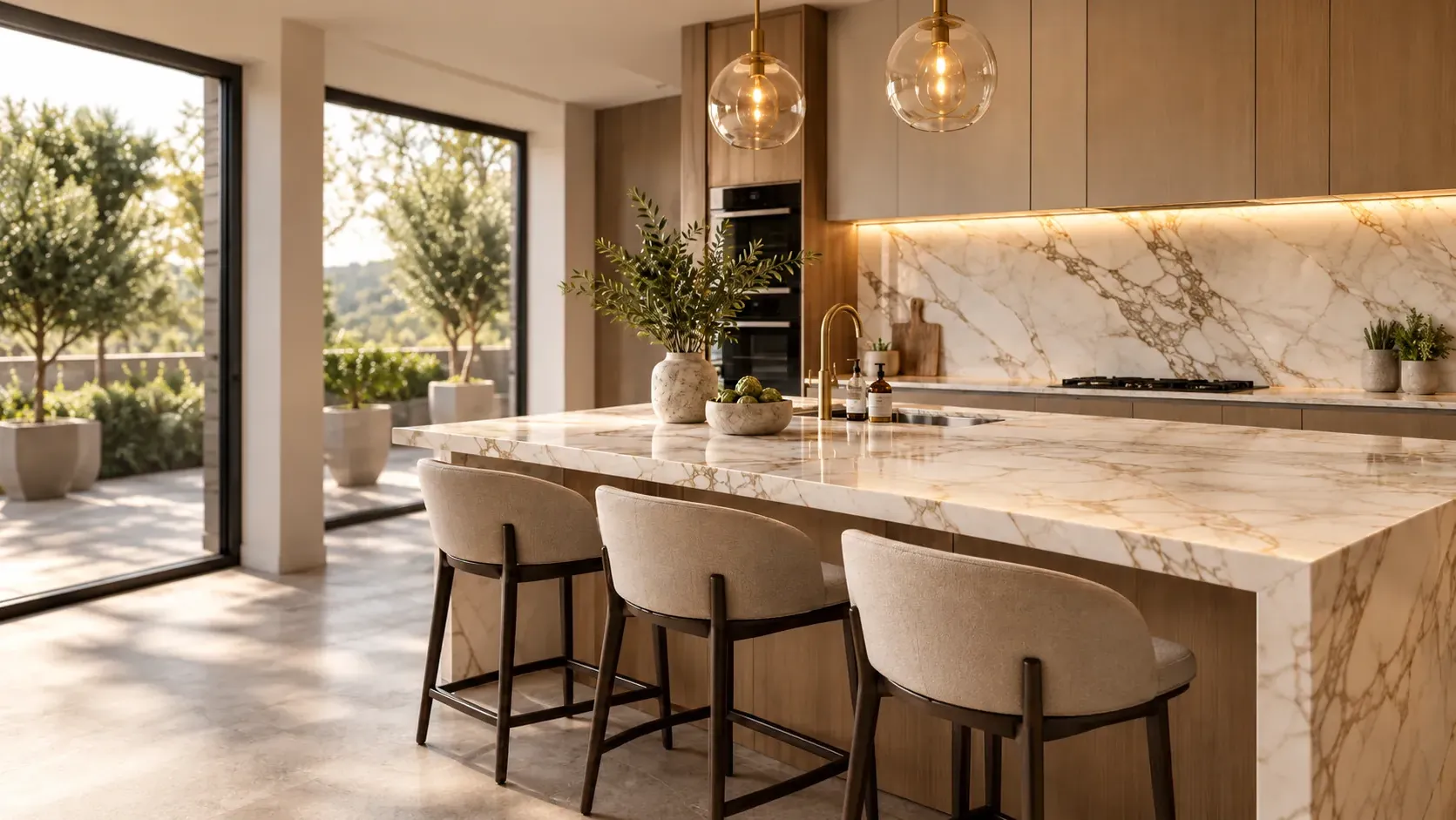
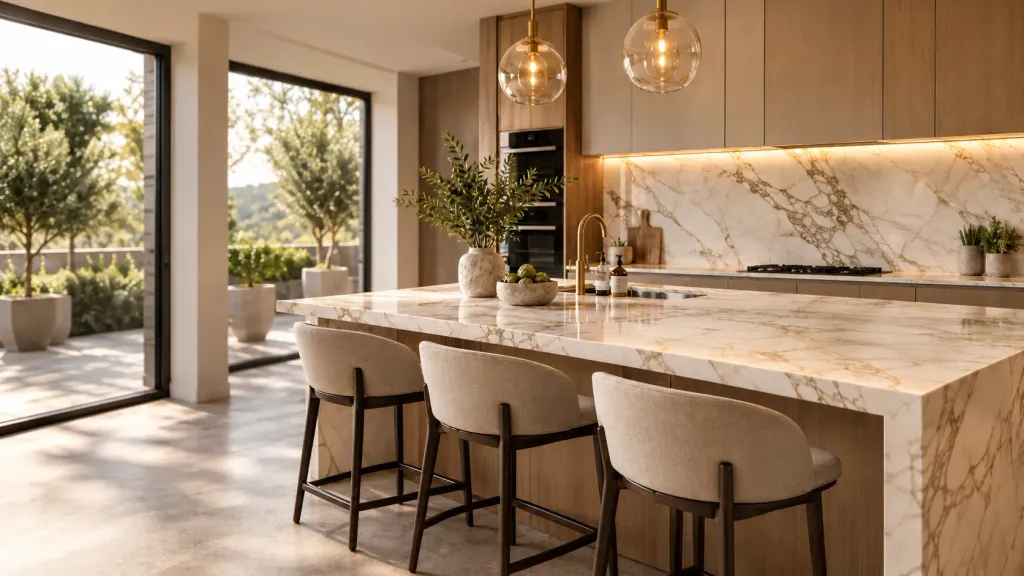
Quartz, granite, quartzite and porcelain are all hard, good-looking kitchen worktops. They differ in three things that matter every day: what a hot pan does, whether the stone needs sealing, and whether your slab is one of a kind.
The short version: quartz needs no sealing but does not like heat. Granite and quartzite take a hot pan and are unique, but are sealed about once a year. Porcelain takes heat, never needs sealing and even works outdoors, but its edges are the vulnerable part. Marble and onyx are the beautiful ones that ask the most of you.
The six materials, compared
Every stone has a weak point, and knowing it before you buy is what stops a worktop from disappointing you. Pick a criterion to see how the six line up.
| Material | Sealing | Hot pan straight down | Lemon, vinegar, wine | Sunlight | Repair | One of a kind |
|---|---|---|---|---|---|---|
| Quartz | Never | No, the resin can scorch | No effect | Can shift over years | Difficult, chips are filled | No, made to a recipe |
| Granite | Yes, about yearly | Yes | Resists it well | Colourfast | Yes, honed on site | Yes, every slab |
| Quartzite | Yes, about yearly | Yes | Resists most | Colourfast | Yes, re-polished on site | Yes, every slab |
| Porcelain | Never | Yes | No effect | Colourfast, outdoor safe | Limited | No, a printed pattern |
| Marble | Yes, about yearly | Use a trivet | Etches where it sits | Colourfast | Yes, honed on site | Yes, every slab |
| Onyx | Yes, regularly | Use a trivet | Etches where it sits | Can fade in strong sun | Yes, honed on site | Yes, every slab |
Each material up close
What each one is, what it is good at and the one thing to know before you choose it.
Pick a material
Facts, upkeep and a link to the stones we cut.
Quartz
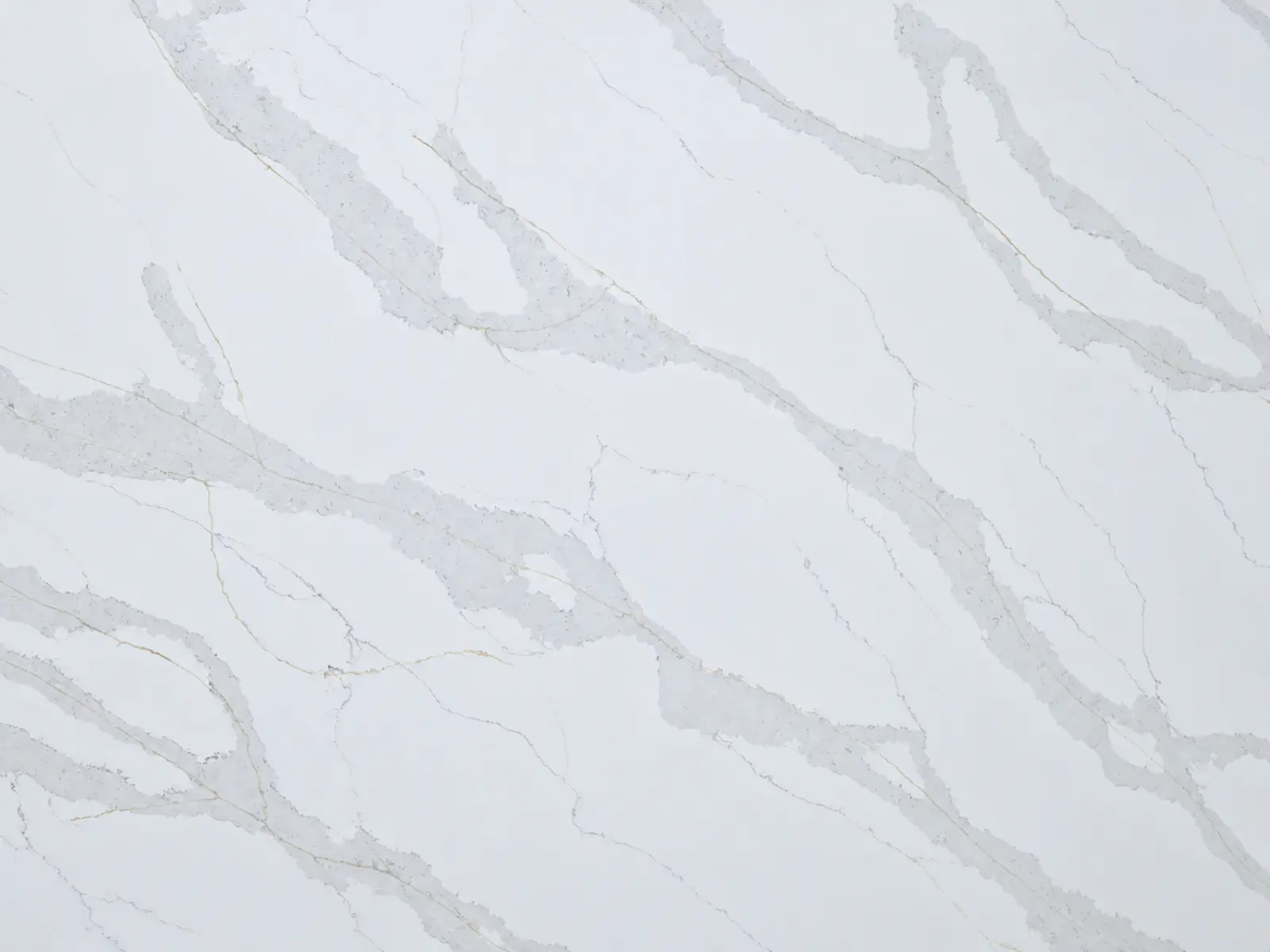
Quartz crystals bound with resin and pressed into slabs. Nothing soaks in and there is no sealing, and a second slab matches the first. The weak point is heat: the resin can scorch, so a trivet is not optional.
- Sealing:
- Never
- Hot pan straight down:
- No, the resin can scorch
- Lemon, vinegar, wine:
- No effect
- Sunlight:
- Can shift over years
- Repair:
- Difficult, chips are filled
- One of a kind:
- No, made to a recipe
Quartz or granite?
This is the choice most kitchens come down to. Quartz is engineered from quartz crystals and resin, so nothing soaks in, there is no sealer to remember, and a second slab matches the first on a long run or an island. Its weak point is heat: the resin can scorch under a pan straight off the hob, so a trivet is not optional.
Granite is quarried, so the pattern was formed in the ground and no two slabs are the same. A casserole off the hob does not mark it, and a scratch or a dull patch can be honed and re-polished on site years later. It is porous, so it is sealed when fitted and then roughly once a year.
Quartz or quartzite?
The names are close and the stones are not. Quartz is made; quartzite is natural stone, sandstone turned to quartz crystal under heat and pressure. Quartzite carries long marble-like veining but is one of the hardest natural worktop stones, and with no resin in it a hot pan does not scorch it. Some stones sold as quartzite are softer and closer to marble, so ask which kind a slab is before you choose it.
Porcelain: heat, light and stains do nothing
Porcelain is fired at well over 1,000 degrees into an ultra-compact slab. Water absorption is effectively nil, so there is nothing to seal, and a hot pan or strong sun does not change it: it is the one surface in our range that also works outdoors. The edge is the vulnerable part. A heavy knock on a mitred corner can chip it, and on some ranges the veining sits on the surface rather than through the body.
How much worktop do you need?
Worktops are priced from your kitchen, not from a list: the size of each run, the thickness, the edge, the cut-outs for the sink and hob, and whether you add upstands or an island. The calculator gives you the worktop area and a rough slab count to start the conversation.
For a price, send us your measurements: you get a drawing and a written quote within 1 working day.
Before you choose
Still deciding? Browse every stone we cut, see the edge profiles, or read whether to choose an upstand or a full splashback.